Posts in Category: AI
AI-Driven Platform in AWS
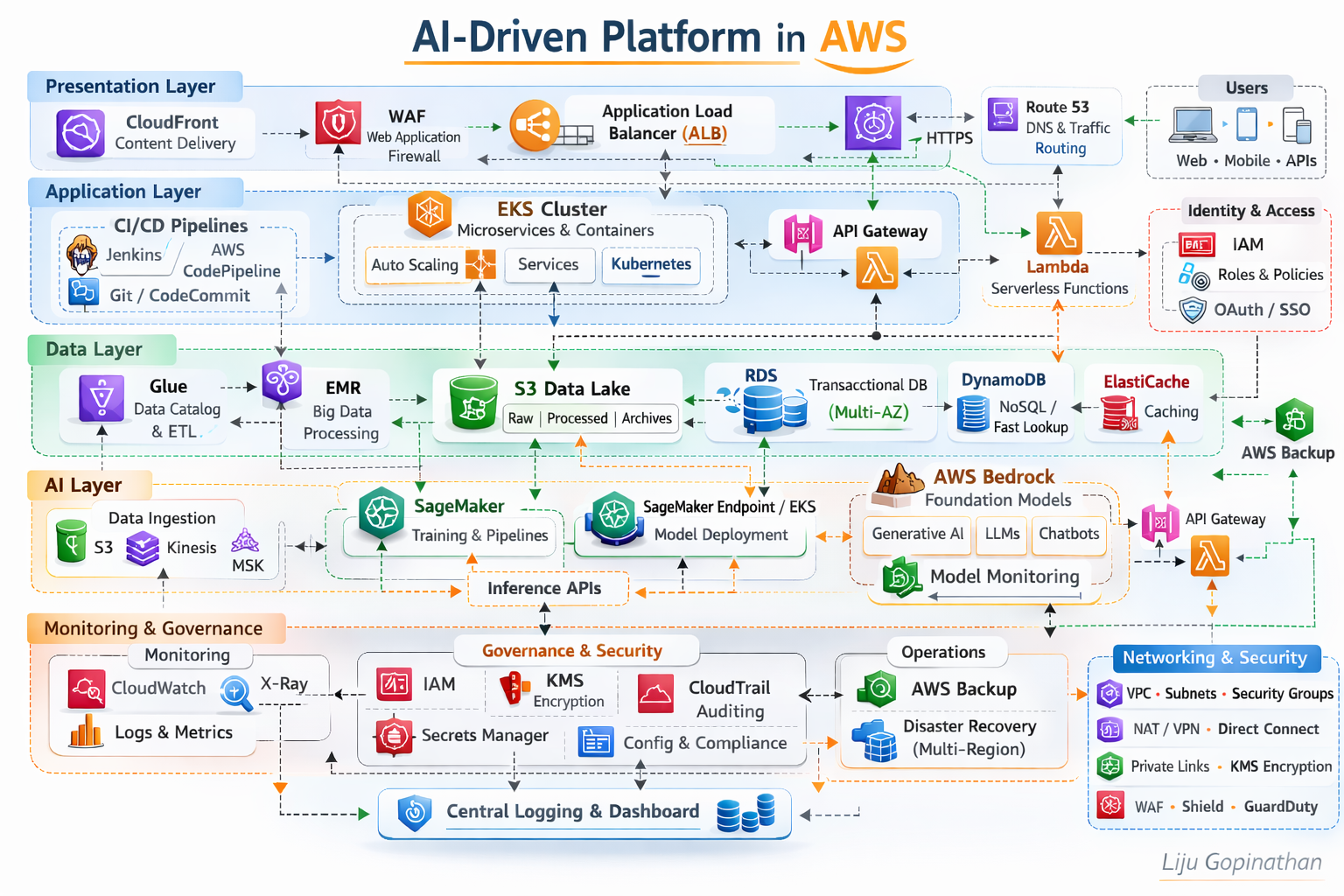
A Layered, Secure, Scalable and AI-Ready Cloud Architecture
This architecture represents a modern, enterprise-grade AI-driven platform built natively on AWS. It follows a layered architectural model aligned to AWS best practices, the AWS Well-Architected Framework, and modern cloud-native and MLOps principles.
The platform is structured into five logical layers:
- Presentation Layer
- Application Layer
- Data Layer
- AI/ML Layer
- Monitoring, Governance & Security
Each layer is independently scalable, loosely coupled, and secured by design.
Presentation Layer – Edge Optimised and Secure
The Presentation Layer is responsible for global traffic distribution, edge security, and controlled ingress into the platform.
Key Components:
- Amazon CloudFront
- AWS WAF
- Application Load Balancer (ALB)
- Route 53
Architecture Rationale:
Amazon CloudFront provides low-latency global content delivery and acts as the first entry point for users (Web, Mobile, APIs). It improves performance while reducing origin load.
AWS WAF enforces Layer 7 security policies, protecting against OWASP top 10 vulnerabilities, bot traffic, and malicious payloads.
Application Load Balancer (ALB) routes HTTPS/WebSocket traffic into backend services based on path-based or host-based routing rules.
Route 53 ensures highly available DNS resolution and intelligent traffic routing.
This layer ensures:
- Global scalability
- DDoS mitigation (via Shield integration)
- TLS termination
- Secure API ingress
Application Layer – Cloud-Native Compute & Microservices
The Application Layer is built around containerised and serverless patterns.
Key Components:
- Amazon EKS (Kubernetes)
- AWS Lambda
- Amazon API Gateway
- CI/CD (Jenkins, AWS CodePipeline, Git)
Architecture Rationale:
Amazon EKS orchestrates containerised microservices using Kubernetes. It supports:
- Horizontal Pod Autoscaling
- Service mesh integration (if required)
- Rolling deployments
- Multi-AZ resilience
Microservices are packaged as Docker containers and deployed through automated CI/CD pipelines.
AWS Lambda supports event-driven workloads and lightweight APIs, reducing operational overhead.
Amazon API Gateway exposes REST/HTTP APIs securely, enabling throttling, authentication, and monitoring.
CI/CD pipelines ensure:
- Infrastructure as Code (Terraform/CloudFormation)
- Automated deployments
- DevSecOps integration
- Blue/Green or Canary releases
This layer provides:
- Elastic scaling
- Service isolation
- Zero-downtime deployments
- Microservices-based modularity
Data Layer – Multi-Model Data Platform
The Data Layer supports transactional, analytical, and AI workloads.
Key Components:
- Amazon RDS (Multi-AZ)
- Amazon DynamoDB
- Amazon S3 (Data Lake)
- AWS Glue
- AWS EMR
- ElastiCache
Architecture Rationale:
Amazon RDS (Multi-AZ) provides high availability for relational transactional workloads.
Amazon DynamoDB handles high-throughput, low-latency NoSQL use cases.
Amazon S3 acts as the central data lake:
- Raw data
- Processed data
- Model artifacts
- Logs and archives
AWS Glue manages metadata cataloguing and ETL orchestration.
Amazon EMR supports distributed big data processing (Spark/Hadoop).
ElastiCache improves performance through in-memory caching.
This layer enables:
- Hybrid OLTP + analytical workloads
- Structured and unstructured data support
- AI feature pipelines
- Scalable storage and processing
AI Layer – MLOps & Generative AI Enablement
The AI Layer integrates traditional ML and Generative AI capabilities.
Key Components:
- Amazon SageMaker (Training, Pipelines, Model Registry)
- SageMaker Endpoints / EKS for inference
- AWS Bedrock (Foundation Models)
- Feature Store
- Streaming ingestion (Kinesis/MSK)
Architecture Rationale:
Amazon SageMaker enables:
- Model training
- Hyperparameter tuning
- Managed pipelines
- Model versioning
- Automated MLOps lifecycle
Models are deployed through:
- SageMaker Endpoints (managed inference)
- EKS (customised containerised inference)
AWS Bedrock integrates foundation models such as Claude, Titan, LLaMA, enabling:
- Generative AI applications
- Chatbots
- Document summarisation
- Intelligent automation
The architecture supports:
- Batch inference
- Real-time inference APIs
- Model monitoring
- Responsible AI governance
This layer enables the platform to be:
- AI-first
- GenAI-ready
- MLOps governed
- Scalable for enterprise workloads
Monitoring, Governance & Security – Cross-Layer Controls
Security and observability are embedded across all layers.
Monitoring Components:
- Amazon CloudWatch (Metrics & Logs)
- AWS X-Ray (Tracing)
- AWS CloudTrail (Auditing)
Governance & Security:
- IAM (Role-based access control)
- KMS (Encryption at rest)
- Secrets Manager
- VPC segmentation
- Security Groups
- AWS Backup
- Multi-Region Disaster Recovery
Architecture Principles:
IAM Roles & Policies enforce least privilege access per persona:
- Developer
- Deployer
- Operations
- AI Engineer
KMS ensures encryption of:
- S3
- RDS
- DynamoDB
- Model artifacts
CloudTrail ensures auditability for compliance-heavy industries.
AWS Backup + Multi-Region strategy ensures business continuity.
This governance model aligns with:
- Security pillar of Well-Architected Framework
- Compliance-driven industries
- Enterprise-grade audit requirements
Architectural Characteristics
This platform demonstrates:
- Multi-AZ high availability
- Horizontal scalability
- Microservices architecture
- MLOps lifecycle integration
- Generative AI capability
- Event-driven extensibility
- Secure-by-design networking
- Infrastructure as Code automation
Design Philosophy
It reflects modern enterprise cloud architecture principles where AI is not an add-on but a native capability within the platform. This architecture is intentionally layered to :
- Separate concerns across compute, data and AI
- Enable independent scaling
- Reduce blast radius
- Improve governance
- Accelerate innovation without compromising security
Enterprise Azure Data & AI Platform
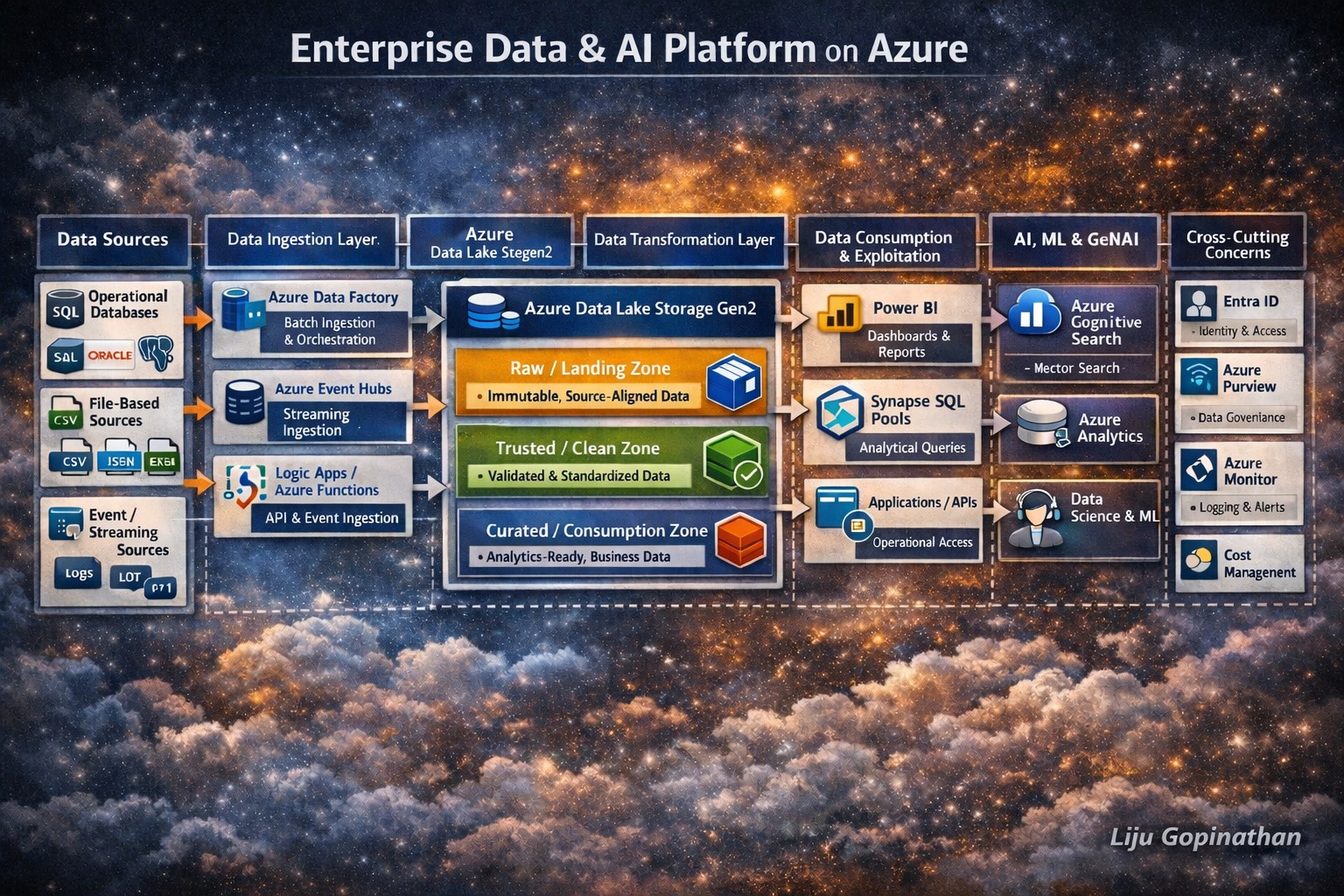
End-to-End Data Lifecycle Architecture Using Azure Native Services
Modern enterprises require more than isolated analytics or AI solutions. They need a cohesive, governed and scalable data platform that supports the entire data lifecycle from ingestion to transformation, analytics, machine learning and Generative AI.
The architecture illustrated above represents a holistic Enterprise Data & AI Platform built entirely using Azure native services. It demonstrates how data flows securely and reliably from multiple source systems, through structured processing layers and ultimately into consumption and AI/GenAI workloads.
This design reflects real-world enterprise patterns, aligned with regulated environments, cloud best practices and modern data platform principles.
Architectural Principles
This platform is designed around the following core principles:
- Separation of concerns across ingestion, storage, processing, and consumption
- Lakehouse-style architecture using Azure Data Lake as the backbone
- ELT-first approach (Extract → Load → Transform)
- Governance and security embedded at every layer
- AI and GenAI readiness by design, not as an afterthought
- Azure-native services only, ensuring long-term support and integration
1. Data Sources Layer
The data lifecycle begins with diverse enterprise data sources, which typically include:
- Operational DatabasesExamples: SQL Server, Oracle, PostgreSQLThese systems generate transactional and reference data critical for analytics and AI.
- File-Based SourcesFormats such as CSV, JSON, Excel, Parquet originating from internal systems, partners, or legacy platforms.
- SaaS & Application DataData exposed via REST APIs from CRM, ERP, ticketing, or third-party platforms.
- Event & Streaming SourcesApplication events, telemetry, logs, and IoT data produced continuously in near real time.
This layer is intentionally technology-agnostic, representing any system capable of producing data.
2. Data Ingestion Layer (Azure Native)
The ingestion layer is responsible for reliably moving data into Azure, without applying heavy business logic.
Azure Data Factory (ADF)
Azure Data Factory acts as the primary batch ingestion and orchestration service.
Key responsibilities:
- Scheduled and on-demand ingestion
- Source-to-lake data movement
- Pipeline orchestration and dependency management
- Metadata-driven ingestion patterns
ADF is deliberately used for data movement and orchestration, not complex transformations.
Azure Event Hubs
Azure Event Hubs supports streaming and real-time ingestion.
Typical use cases:
- Application logs
- Clickstream data
- IoT telemetry
- Event-driven business workflows
Event data is treated as a first-class citizen, landing in the same lake structure as batch data to ensure unified processing.
Azure Logic Apps & Azure Functions
These services enable API-based and event-driven ingestion.
They are used for:
- REST API integrations
- SaaS data ingestion
- Lightweight preprocessing
- Handling authentication, retries, and throttling
This pattern allows ingestion to remain loosely coupled and extensible.
3. Landing Zone – Azure Data Lake Storage Gen2
Azure Data Lake Storage Gen2 (ADLS Gen2) forms the central backbone of the platform.
It is organised into logical zones, each with a clear purpose.
Raw / Landing Zone
- Stores data exactly as received
- Immutable and append-only
- Preserves original structure and semantics
- Enables replay, audit, and lineage
No analytics or AI workloads directly access this zone.
Trusted / Clean Zone
- Basic data quality checks
- Schema validation and standardisation
- Removal of corrupt or invalid records
- Normalisation of formats
This zone represents technically reliable data, but not yet business-optimised.
Curated / Consumption Zone
- Business-aligned datasets
- Optimised storage formats (e.g., Parquet, Delta)
- Designed for analytics, ML, and GenAI consumption
- Domain- or subject-area oriented
This is the only zone exposed to downstream consumers.
4. Data Transformation & Processing Layer
Transformation is performed after data is safely landed, following an ELT model.
Azure Databricks
Azure Databricks is the primary large-scale transformation and feature engineering engine.
Responsibilities:
- Data cleansing and enrichment
- Complex joins and aggregations
- Incremental processing
- Feature creation for ML workloads
- Delta Lake-based reliability and versioning
Databricks supports both batch and streaming transformations, ensuring consistency across data types.
Azure Synapse Analytics
Azure Synapse complements Databricks by enabling:
- SQL-based analytical transformations
- Data modelling and serving
- Integration with BI tools
- Analytical views over curated datasets
Synapse acts as the bridge between data engineering and analytics.
5. Data Consumption & Exploitation Layer
Once data is curated, it becomes available for controlled and governed consumption.
Power BI
Used for:
- Enterprise reporting
- Dashboards
- Self-service analytics
Power BI connects only to curated and approved datasets.
Azure Synapse SQL Pools
Provide:
- High-performance analytical querying
- SQL access for analysts and applications
- Consistent semantic models
Applications & APIs
Curated data can be exposed via APIs to:
- Internal applications
- Downstream systems
- Operational reporting tools
Data Science & Advanced Analytics
Data scientists access curated datasets for:
- Exploratory analysis
- Feature experimentation
- Model development
Direct access to raw data is intentionally restricted.
6. AI, ML & Generative AI Enablement
The platform is designed to natively support AI and GenAI workloads.
Azure Machine Learning
Azure Machine Learning manages the full ML lifecycle:
- Training and experimentation
- Feature consumption
- Model registry
- Deployment and monitoring
It consumes governed, curated data, ensuring reproducibility and compliance.
Azure Cognitive Search
Azure Cognitive Search enables:
- Full-text search
- Semantic search
- Vector search for embeddings
It is a key component for Retrieval-Augmented Generation (RAG) patterns.
Azure OpenAI Service
Azure OpenAI provides LLM inference capabilities.
In a RAG pattern:
- Curated documents are indexed in Cognitive Search
- Relevant context is retrieved using vector search
- Context is passed to Azure OpenAI
- Grounded, auditable responses are generated
This ensures:
- Reduced hallucination
- Data boundary enforcement
- Enterprise-grade GenAI usage
7. Security, Governance & Observability (Cross-Cutting)
Security and governance span every layer of the architecture.
Microsoft Entra ID (Azure AD)
- Identity and access management
- Role-based access control (RBAC)
Managed Identities
- Secure service-to-service authentication
- No secrets embedded in code
Microsoft Purview
- Data catalog
- Lineage tracking
- Classification and governance
Azure Monitor & Log Analytics
- End-to-end observability
- Operational monitoring
- Troubleshooting and alerting
Cost Management
- Visibility into data and AI workloads
- Cost optimisation and governance
End-to-End Lifecycle Summary
This architecture illustrates a complete enterprise data lifecycle:
- Ingest data from any source
- Land it safely and immutably
- Transform it through governed layers
- Consume it via analytics and APIs
- Enable AI & GenAI using trusted data
- Secure and govern everything end-to-end
Why This Architecture Matters
This design demonstrates:
- Cloud-native best practices
- AI-first data platform thinking
- Strong governance and compliance
- Scalability and extensibility
- Real-world enterprise applicability
It moves beyond “data pipelines” into a true enterprise data and AI platform.
AI Mastery Roadmap 2026: A Comprehensive Learning Journey
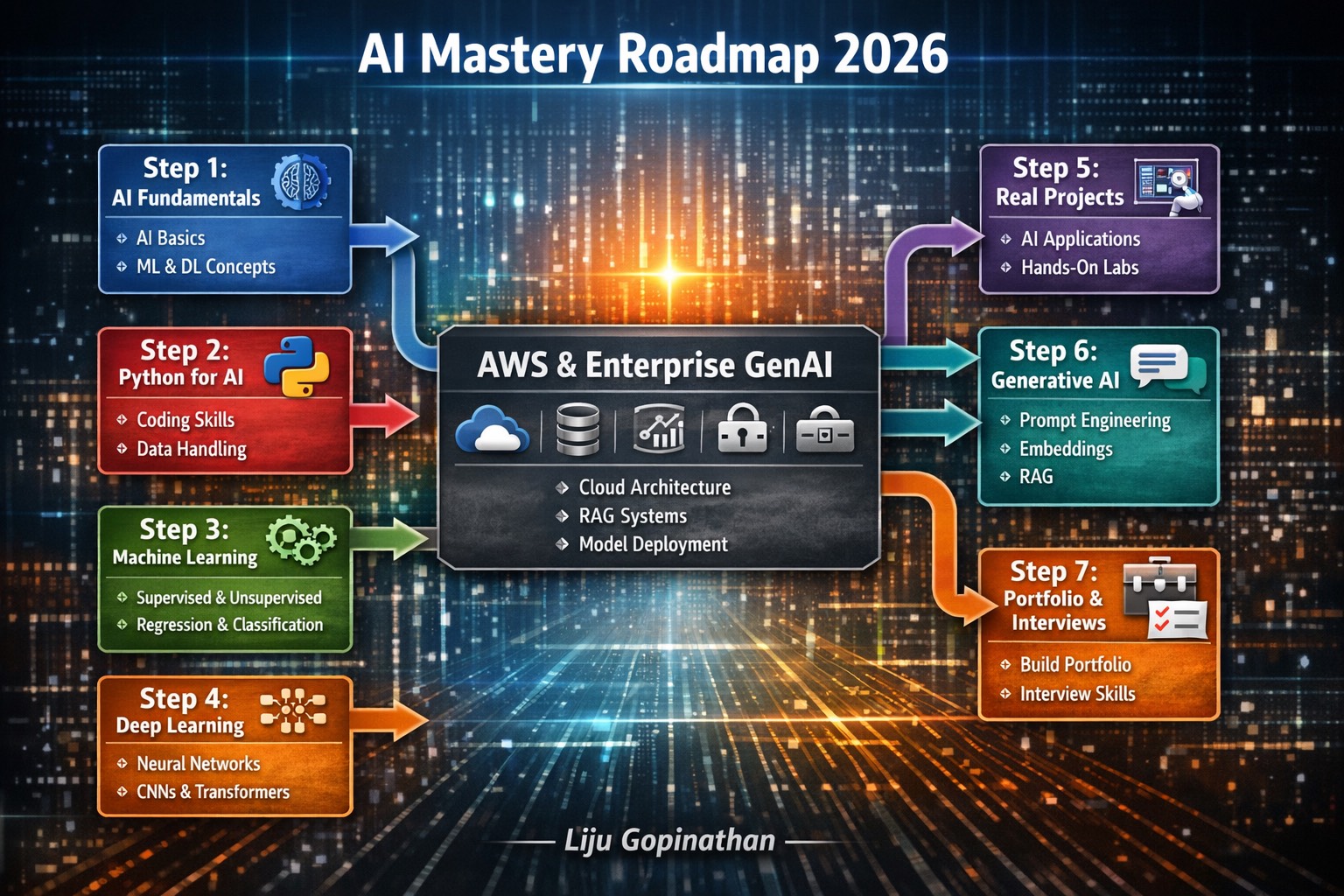
In today’s rapidly evolving AI landscape, mastering the field requires a structured, methodical approach. The “AI Mastery Roadmap 2026” infographic serves as a comprehensive guide, detailing the essential steps to become proficient in artificial intelligence. From foundational concepts to advanced enterprise applications, this roadmap encapsulates the entire journey.
Key Highlights:
- Step 1: AI Fundamentals – Start with the basics of AI, machine learning (ML) and deep learning (DL). This foundational layer ensures a solid understanding of core principles and prepares you for more complex topics.
- Step 2: Python for AI – Dive into Python, the cornerstone language for AI development. Learn coding skills and data handling techniques that are critical for building and deploying AI models.
- Step 3: Machine Learning – Explore the intricacies of ML, including supervised and unsupervised learning, regression and classification. This step empowers you to create predictive models and analyze data patterns.
- Step 4: Deep Learning – Delve into deep learning with neural networks, CNNs, and transformers. This phase introduces you to advanced model architectures, enabling you to tackle complex tasks like image recognition and natural language processing.
- Step 5: Real Projects – Apply your skills through hands-on AI projects. This practical experience solidifies your learning and showcases your ability to implement AI solutions in real-world scenarios.
- Step 6: Generative AI – Master generative AI techniques, including prompt engineering and Retrieval-Augmented Generation (RAG). Learn how to create innovative AI applications that generate content and provide intelligent responses.
- Step 7: Portfolio & Interviews – Build a robust portfolio and prepare for interviews. This final step focuses on showcasing your projects, refining your professional profile and excelling in AI-related job interviews.
Conclusion:
The “AI Mastery Roadmap 2026” is more than just a learning guide—it’s a strategic plan to elevate your AI expertise. By following this roadmap, you will gain the knowledge, skills and confidence needed to excel in the AI field.
Enterprise GenAI Platform on AWS: Building Secure and Scalable AI Solutions
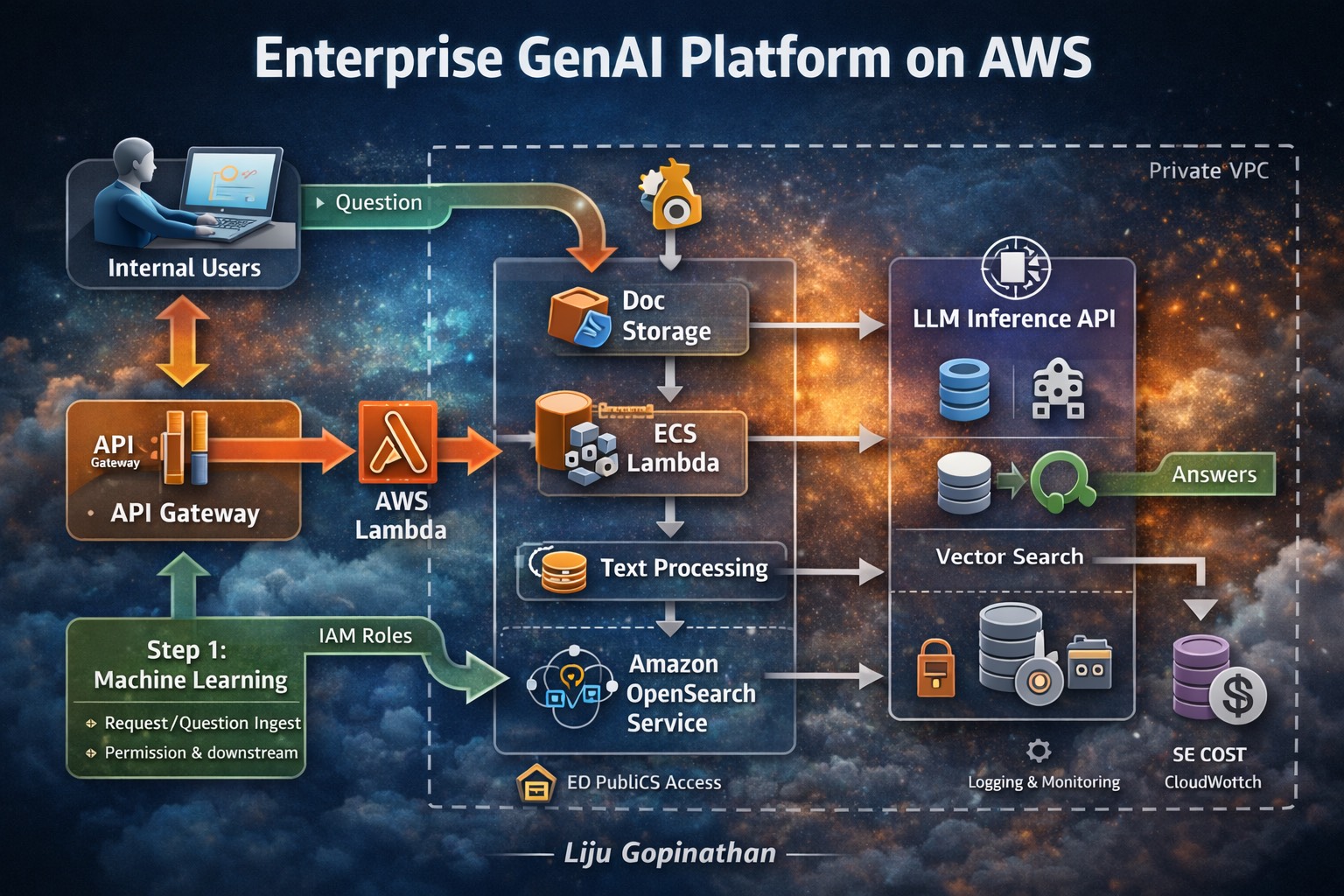
In the era of enterprise AI, the integration of Generative AI (GenAI) with robust cloud infrastructure is key to unlocking transformative business solutions. The “Enterprise GenAI Platform on AWS” infographic illustrates how a comprehensive Retrieval-Augmented Generation (RAG) system can be effectively built on AWS, ensuring security, scalability and efficiency.
Key Highlights:
- Internal Users: The platform begins with internal users, who initiate queries and requests, driving the need for intelligent and secure responses.
- API Gateway & AWS Lambda: The API Gateway serves as the entry point for user requests, routing them to AWS Lambda for processing. This serverless architecture ensures flexibility, scalability, and cost-efficiency.
- Document Storage & Text Processing: Documents are securely stored in AWS S3, and ECS Lambda functions handle text processing, ensuring that data is effectively ingested and prepared for retrieval.
- Amazon OpenSearch Service: For efficient search and retrieval, the platform leverages Amazon OpenSearch, allowing for quick and accurate vector searches across large datasets.
- LLM Inference API: The core of the GenAI platform is the LLM Inference API, which generates intelligent responses based on the retrieved data. This ensures that answers are both accurate and contextually relevant.
- Security & Cost Management: The entire platform operates within a private VPC, with IAM roles managing permissions. Monitoring and cost control are handled via AWS CloudWatch, ensuring that the system remains secure and cost-effective.
The “Enterprise GenAI Platform on AWS” infographic demonstrates the seamless integration of cutting-edge AI capabilities with AWS services. By adopting this architecture, enterprises can build secure, scalable, and intelligent AI solutions that drive business innovation and efficiency.