
AI-Driven Platform in AWS
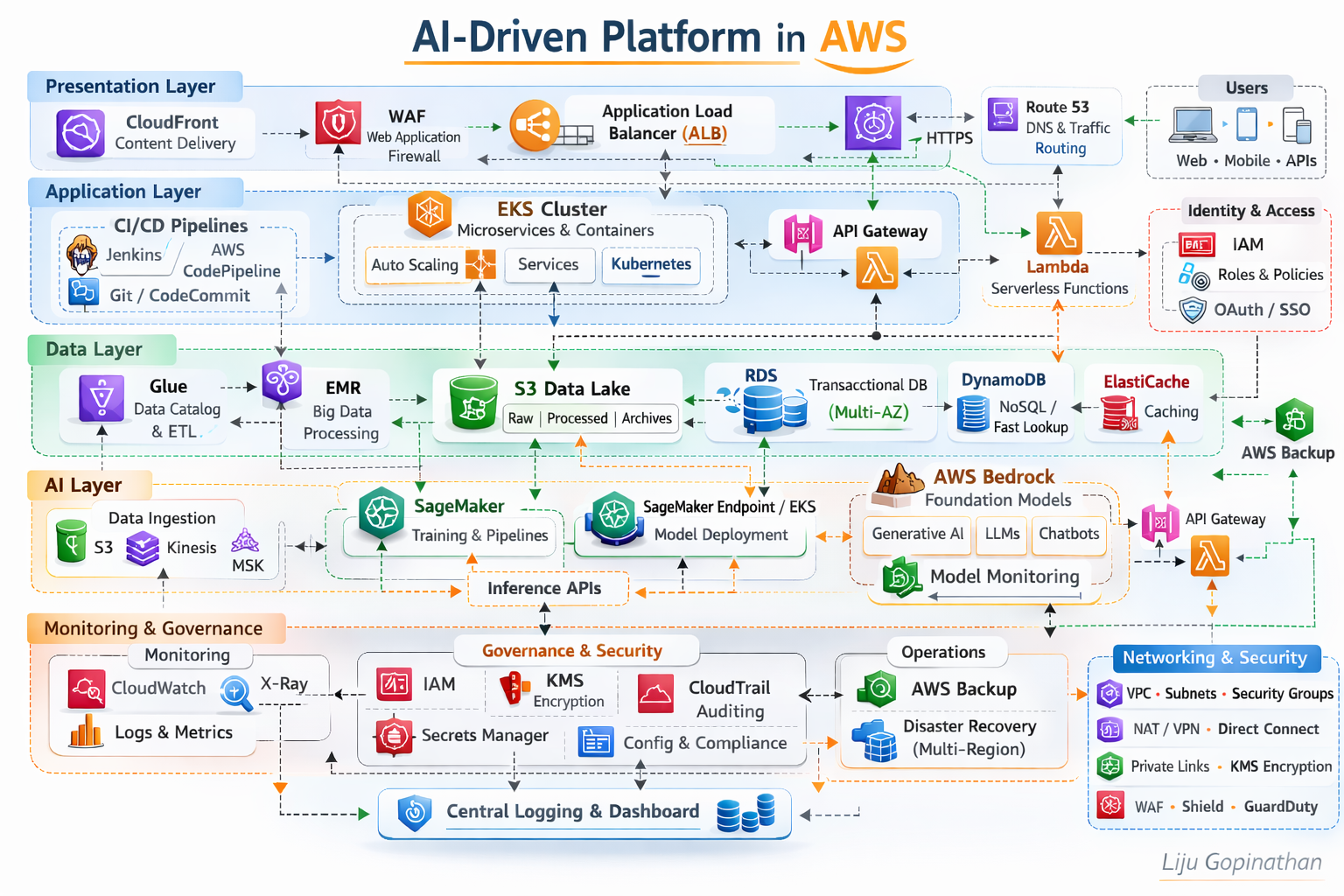
A Layered, Secure, Scalable and AI-Ready Cloud Architecture
This architecture represents a modern, enterprise-grade AI-driven platform built natively on AWS. It follows a layered architectural model aligned to AWS best practices, the AWS Well-Architected Framework, and modern cloud-native and MLOps principles.
The platform is structured into five logical layers:
- Presentation Layer
- Application Layer
- Data Layer
- AI/ML Layer
- Monitoring, Governance & Security
Each layer is independently scalable, loosely coupled, and secured by design.
Presentation Layer – Edge Optimised and Secure
The Presentation Layer is responsible for global traffic distribution, edge security, and controlled ingress into the platform.
Key Components:
- Amazon CloudFront
- AWS WAF
- Application Load Balancer (ALB)
- Route 53
Architecture Rationale:
Amazon CloudFront provides low-latency global content delivery and acts as the first entry point for users (Web, Mobile, APIs). It improves performance while reducing origin load.
AWS WAF enforces Layer 7 security policies, protecting against OWASP top 10 vulnerabilities, bot traffic, and malicious payloads.
Application Load Balancer (ALB) routes HTTPS/WebSocket traffic into backend services based on path-based or host-based routing rules.
Route 53 ensures highly available DNS resolution and intelligent traffic routing.
This layer ensures:
- Global scalability
- DDoS mitigation (via Shield integration)
- TLS termination
- Secure API ingress
Application Layer – Cloud-Native Compute & Microservices
The Application Layer is built around containerised and serverless patterns.
Key Components:
- Amazon EKS (Kubernetes)
- AWS Lambda
- Amazon API Gateway
- CI/CD (Jenkins, AWS CodePipeline, Git)
Architecture Rationale:
Amazon EKS orchestrates containerised microservices using Kubernetes. It supports:
- Horizontal Pod Autoscaling
- Service mesh integration (if required)
- Rolling deployments
- Multi-AZ resilience
Microservices are packaged as Docker containers and deployed through automated CI/CD pipelines.
AWS Lambda supports event-driven workloads and lightweight APIs, reducing operational overhead.
Amazon API Gateway exposes REST/HTTP APIs securely, enabling throttling, authentication, and monitoring.
CI/CD pipelines ensure:
- Infrastructure as Code (Terraform/CloudFormation)
- Automated deployments
- DevSecOps integration
- Blue/Green or Canary releases
This layer provides:
- Elastic scaling
- Service isolation
- Zero-downtime deployments
- Microservices-based modularity
Data Layer – Multi-Model Data Platform
The Data Layer supports transactional, analytical, and AI workloads.
Key Components:
- Amazon RDS (Multi-AZ)
- Amazon DynamoDB
- Amazon S3 (Data Lake)
- AWS Glue
- AWS EMR
- ElastiCache
Architecture Rationale:
Amazon RDS (Multi-AZ) provides high availability for relational transactional workloads.
Amazon DynamoDB handles high-throughput, low-latency NoSQL use cases.
Amazon S3 acts as the central data lake:
- Raw data
- Processed data
- Model artifacts
- Logs and archives
AWS Glue manages metadata cataloguing and ETL orchestration.
Amazon EMR supports distributed big data processing (Spark/Hadoop).
ElastiCache improves performance through in-memory caching.
This layer enables:
- Hybrid OLTP + analytical workloads
- Structured and unstructured data support
- AI feature pipelines
- Scalable storage and processing
AI Layer – MLOps & Generative AI Enablement
The AI Layer integrates traditional ML and Generative AI capabilities.
Key Components:
- Amazon SageMaker (Training, Pipelines, Model Registry)
- SageMaker Endpoints / EKS for inference
- AWS Bedrock (Foundation Models)
- Feature Store
- Streaming ingestion (Kinesis/MSK)
Architecture Rationale:
Amazon SageMaker enables:
- Model training
- Hyperparameter tuning
- Managed pipelines
- Model versioning
- Automated MLOps lifecycle
Models are deployed through:
- SageMaker Endpoints (managed inference)
- EKS (customised containerised inference)
AWS Bedrock integrates foundation models such as Claude, Titan, LLaMA, enabling:
- Generative AI applications
- Chatbots
- Document summarisation
- Intelligent automation
The architecture supports:
- Batch inference
- Real-time inference APIs
- Model monitoring
- Responsible AI governance
This layer enables the platform to be:
- AI-first
- GenAI-ready
- MLOps governed
- Scalable for enterprise workloads
Monitoring, Governance & Security – Cross-Layer Controls
Security and observability are embedded across all layers.
Monitoring Components:
- Amazon CloudWatch (Metrics & Logs)
- AWS X-Ray (Tracing)
- AWS CloudTrail (Auditing)
Governance & Security:
- IAM (Role-based access control)
- KMS (Encryption at rest)
- Secrets Manager
- VPC segmentation
- Security Groups
- AWS Backup
- Multi-Region Disaster Recovery
Architecture Principles:
IAM Roles & Policies enforce least privilege access per persona:
- Developer
- Deployer
- Operations
- AI Engineer
KMS ensures encryption of:
- S3
- RDS
- DynamoDB
- Model artifacts
CloudTrail ensures auditability for compliance-heavy industries.
AWS Backup + Multi-Region strategy ensures business continuity.
This governance model aligns with:
- Security pillar of Well-Architected Framework
- Compliance-driven industries
- Enterprise-grade audit requirements
Architectural Characteristics
This platform demonstrates:
- Multi-AZ high availability
- Horizontal scalability
- Microservices architecture
- MLOps lifecycle integration
- Generative AI capability
- Event-driven extensibility
- Secure-by-design networking
- Infrastructure as Code automation
Design Philosophy
It reflects modern enterprise cloud architecture principles where AI is not an add-on but a native capability within the platform. This architecture is intentionally layered to :
- Separate concerns across compute, data and AI
- Enable independent scaling
- Reduce blast radius
- Improve governance
- Accelerate innovation without compromising security